Fintech SaaS SEO: how to rank in a trust-heavy category
Google holds financial content to a higher standard, and so do your buyers. Here is how fintech and lending software companies build rankings that last, based on our work with Cloudsquare.
 Trickency Team
October 21, 2026
4 min read
Fintech, lending and payments software sits in what Google calls “Your Money or Your Life” territory: topics where bad information can cost people money. Google applies stricter quality standards there, and so do buyers. A CFO or a lending operator won’t trust a vendor whose site reads like generic marketing.
We’ve seen this first hand working with Cloudsquare, a loan-servicing and merchant cash advance platform. The content that ranked, and got Cloudsquare named first in Google’s AI Overview for “lendsaas alternative”, was specific, honest and clearly written by people who understand the industry.
Key takeaways
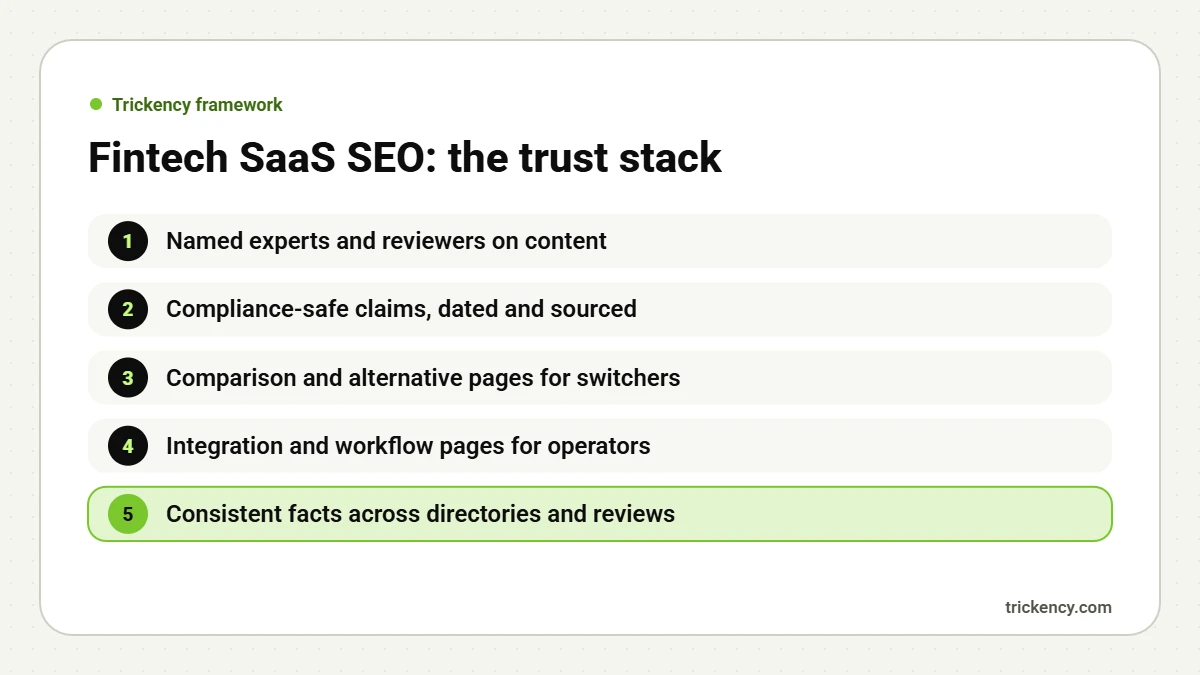
- Show who wrote and reviewed your content, and why they are qualified.
- Keep claims accurate, dated and compliance-safe.
- Win the switching buyer first with alternative and comparison pages.
- Build pages around operators’ real workflows, not generic “fintech” topics.
Why fintech SEO is different
Three things raise the bar:
- Trust signals matter more. Author credentials, company details, security information and reviews all count.
- Claims carry risk. Statements about returns, approval rates or compliance can create legal exposure.
- Buyers are specialists. Funders, underwriters and finance leads spot vague content immediately.
1. Put real experts on the page
Add an author with a real role and short bio to every article, and a “reviewed by” line for anything technical or regulatory. Link to their LinkedIn. This supports Google’s quality guidelines and helps AI assistants attribute statements to a credible source.
2. Make claims you can defend
Agree a simple rule with your compliance or legal lead: every number has a source and a date, and no page promises outcomes the product can’t guarantee. “Teams typically cut reconciliation time” with a customer example beats “Reduce defaults by 50%”.
3. Start with switchers
In established fintech niches, many buyers already use a tool and are unhappy with it. That makes alternative pages and comparison pages the fastest route to qualified demos. For Cloudsquare, pages comparing LendSaaS, OrgMeter and Onyx IQ reached the top of Google within months.
4. Write for the operator’s day
Lending and payments buyers search for workflows: “ISO commission tracking”, “syndication reporting”, “ACH collections for MCA”. Build a page for each core workflow showing how your product handles it, with screenshots and a short FAQ. These pages rank for long-tail terms that generic competitors ignore.
5. Clean up your footprint
Make sure your company details, pricing model and product description match across your site, G2, Capterra, partner directories and LinkedIn. In a trust-heavy category, inconsistencies cost you both rankings and AI recommendations.
6. Measure the right things
Track rankings for workflow and competitor terms, AI mentions for “best [category] software for [use case]”, and demos from organic. See our guide to measuring SEO by pipeline.
Content ideas that work in lending and payments
- Workflow explainers: “How ISO commission tracking works, and where spreadsheets break.”
- Calculators and templates: factor rate to APR converters, syndication split templates, collections schedules. These attract links and repeat visits.
- Regulation explainers: plain-language summaries of disclosure rules by state, reviewed by an expert and dated.
- Switching guides: “Moving from [tool] to [tool]: data, timeline and risks.”
- Glossaries: short, accurate definitions of industry terms. AI assistants draw heavily on clear definitions.
How we approached Cloudsquare
We didn’t start with a blog. We started with the buyers who already knew the category and were unhappy with their current tool. The first pages were alternatives and comparisons for LendSaaS, OrgMeter and Onyx IQ, each with an honest verdict, a side-by-side table and answers to switching questions. Then we built TOFU, MOFU and BOFU content around them so the site covered the full journey. Within months, Cloudsquare ranked #1 for “lendsaas alternative” and “orgmeter alternative” and Google’s AI Overview named it the top LendSaaS alternative. The full story is on our work page.
A compliance-friendly workflow
To keep speed without risk, use a three-tier review: general education goes straight to publish after an editorial check; pages that mention rates, fees or regulations get a quick expert review; anything about performance claims or legal requirements goes to compliance. Keep a shared log of approved claims so writers can reuse them safely.
FAQ
Is SEO worth it for niche fintech software?
Yes. Niche terms have lower volume, but the searchers are usually buyers. A handful of the right rankings can fill a sales calendar.
Do we need legal review for every blog post?
Not every post. Agree content rules up front and route only pages with regulatory or performance claims for review.
How long does fintech SEO take?
Low-competition workflow and alternative terms can move within a few months. Broad category terms take longer.
Working in fintech or lending software? See our fintech marketing approach, or get a free audit of where buyers find your competitors.

The Trickency team writes about SEO, AI search and LinkedIn for B2B SaaS and tech companies, drawing on real client work since 2021.