“Alternative to” pages: how a SaaS ranked #1 on its competitors’ own names
The highest-intent searches in your category often contain a competitor’s name. Here is the exact playbook we used to rank a loan-servicing SaaS #1 for its rivals’ alternative searches.
 Trickency Team
October 20, 2026
6 min read
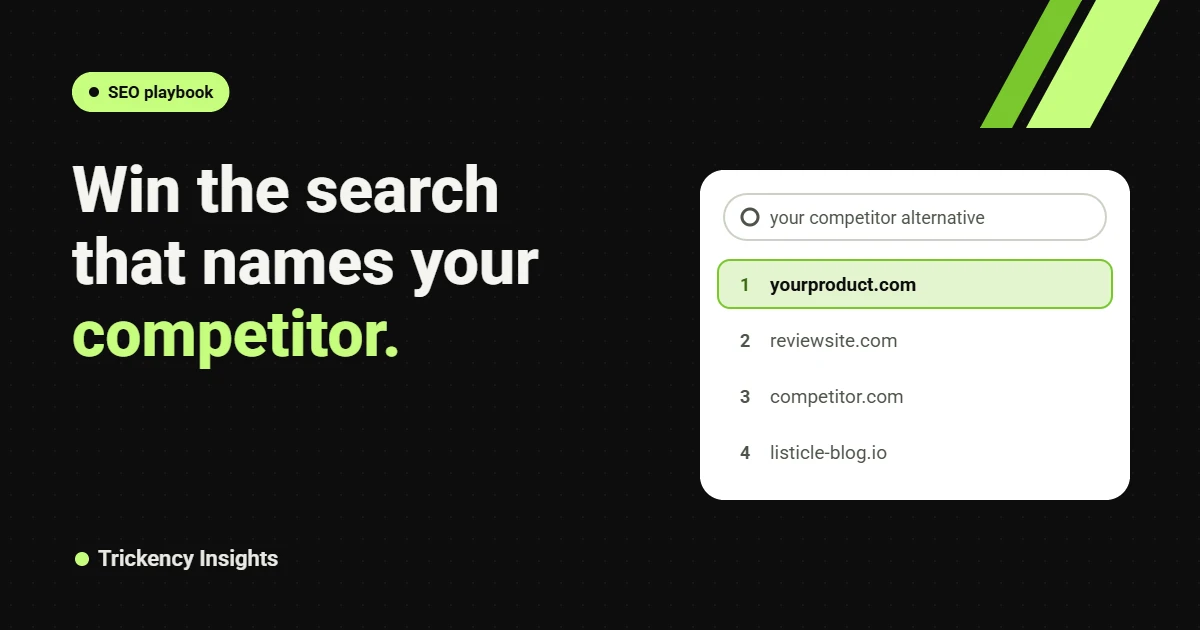
Someone who searches “[competitor] alternative” has already done half your sales work. They know the category, they have used a product in it, and something about that product is pushing them away. It is one of the most valuable searches a B2B SaaS company can rank for, and most teams leave it to review sites.
Earlier this year we built an alternative-page engine for Cloudsquare, a loan-servicing and merchant cash advance platform. Within a few months it ranked #1 on Google for “lendsaas alternative” and “orgmeter alternative”, reached page one for “onyx iq alternative”, and Google’s AI Overview named Cloudsquare first as the top LendSaaS alternative. This post is the playbook behind that result.
Key takeaways
- “Alternative to” searches come from buyers who are ready to switch, so they convert far better than broad category terms.
- Lead with an honest verdict. Pages that only praise your product read as ads and rarely rank or get cited.
- Side-by-side tables and answer-first sections are what Google and AI tools quote.
- One strong page per competitor beats one giant “top 10 alternatives” page.
Why these searches are worth more than your category keyword
Most SaaS SEO plans start with the head term: “loan servicing software”, “project management tool”, “payroll for startups”. Those terms have volume, but the searcher could be a student, a journalist or a buyer two years away from a decision.
A search for “[competitor] alternative” is different. It almost always comes from someone who:
- already uses, or has seriously evaluated, a product in your category,
- has a specific complaint, usually price, missing features or support,
- is actively building a shortlist.
The volume is lower, often a few hundred searches a month, but each visit is close to a demo. That is why we treat these pages as part of bottom-of-funnel SEO, not as content marketing.
Step 1: Pick the competitors buyers are already leaving
Don’t start with the biggest name in your market. Start with the products your sales team hears about on calls. For Cloudsquare that meant LendSaaS, OrgMeter, Onyx IQ, Centrex, LoanPro and LendFoundry.
Check three things for each one:
- Search demand. Does “[name] alternative” or “[name] alternatives” get searches at all? Even 50 a month can be worth a page if deal sizes are large.
- Who ranks now. If the results are thin review-site listicles, you can win. If the competitor ranks with its own comparison page, you need a sharper angle.
- Real fit. Only build pages where your product is a credible choice for that competitor’s customers. Buyers spot a mismatch in seconds.
Step 2: Put an honest verdict at the top
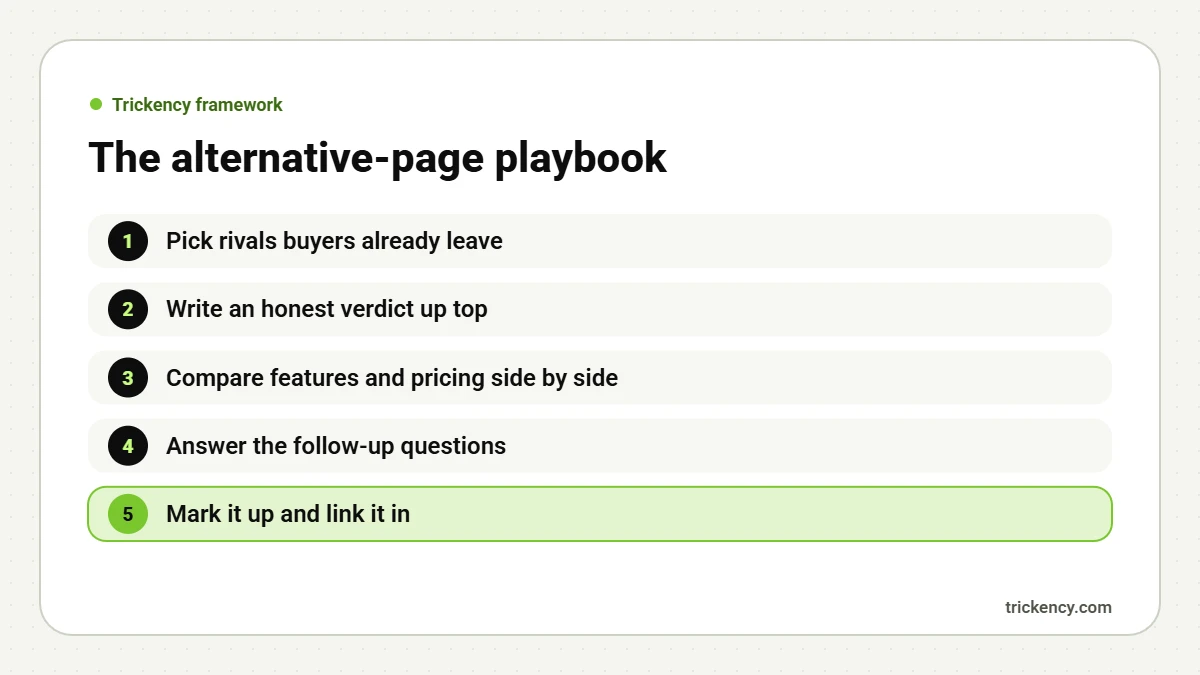
The single biggest difference between pages that rank and pages that don’t is honesty. Open with a short verdict that a buyer could act on: who should stay with the competitor, and who should switch to you.
A verdict like “LendSaaS works well for small funders who need basic tracking. Teams that run syndication, ISO commissions and collections in one place usually outgrow it” does three jobs. It tells the reader you understand their situation. It gives Google a clear answer to match to the query. And it gives AI tools a quotable sentence, which is how Cloudsquare ended up named in the AI Overview.
Step 3: Compare features and pricing side by side
Buyers on these pages want to scan, not read. Give them a table that compares the things they actually decide on: core workflows, integrations, reporting, support, contract terms and pricing model. Where you lose, say so. A table with one honest “No” in your column is more persuasive than a wall of green ticks.
Keep pricing facts dated and sourced, for example “pricing listed on their site, checked June 2026”. That protects you and gives the reader a reason to trust the rest of the page.
Step 4: Answer the questions that come next
After the verdict and the table, a switching buyer has practical worries. Answer them in short sections with question-style headings:
- How long does migration take, and what data comes across?
- Can we run both systems in parallel during the switch?
- What does it cost compared with what we pay now?
- What do we lose by switching?
Write the first sentence of each section as a direct answer. This answer-first structure is what Google’s AI Overviews and assistants like ChatGPT pull from. We cover the wider approach in how B2B brands get cited in AI Overviews.
Step 5: Mark it up and link it in
Add FAQ schema to the question sections and make sure the page has a clear title pattern, such as “Best LendSaaS Alternative for Funders in 2026”. Then link to each alternative page from your pricing page, your product pages and a “Compare” item in the footer. Pages that sit three clicks deep with no internal links rarely rank, however good they are.
What not to do
- Don’t attack the competitor. Name-calling hurts trust and can create legal risk. Stick to verifiable facts.
- Don’t copy their feature list. Describe outcomes in your own words.
- Don’t build one “top 10 alternatives” page and stop. One focused page per competitor matches the search better and gives you more chances to rank.
- Don’t publish and forget. Competitors change pricing and features. Review each page every quarter.
How to measure it
Traffic is the wrong scoreboard here. Track rankings for each “[competitor] alternative” term, mentions in AI answers for “best alternative to [competitor]”, and most importantly demo requests that start on these pages. We explain the full setup in how to measure SEO by pipeline, not traffic.
A page outline you can copy
- H1: “Best [Competitor] Alternative for [Audience] in 2026”.
- Verdict (2–3 sentences): who should stay, who should switch, and why.
- Why teams look for an alternative: the three most common reasons, from reviews and sales calls.
- Side-by-side table: 8–12 rows, plain words, dated.
- How switching works: data, timeline, parallel running.
- Pricing comparison: models and typical ranges.
- FAQ: 4–6 questions with direct answers and schema.
- Next step: one call to action, such as a migration walkthrough.
FAQ
Is it legal to use a competitor’s name on my website?
Generally, using a competitor’s name to make truthful, factual comparisons is accepted practice in most markets. Avoid implying a partnership, don’t use their logo, and keep claims accurate and dated. If in doubt, ask your legal counsel.
How long do alternative pages take to rank?
For low-competition terms, we usually see movement within 4 to 12 weeks. Pages for bigger competitors can take longer and need stronger internal links.
Should I build alternative pages or comparison (“X vs Y”) pages?
Both. Alternative pages capture people leaving a competitor. Comparison pages capture people still choosing between two options.
Want this done for your product? Our SEO and AI search teams build alternative and comparison pages for B2B SaaS. Start with a free audit and we’ll show you which competitor searches you could win first.

The Trickency team writes about SEO, AI search and LinkedIn for B2B SaaS and tech companies, drawing on real client work since 2021.