Google AI Overviews for B2B SaaS: how to get cited instead of skipped
AI Overviews now answer many of the questions your buyers type into Google. Being cited in that answer is the new page one. Here is how B2B tech companies earn the citation.
 Trickency Team
October 20, 2026
5 min read
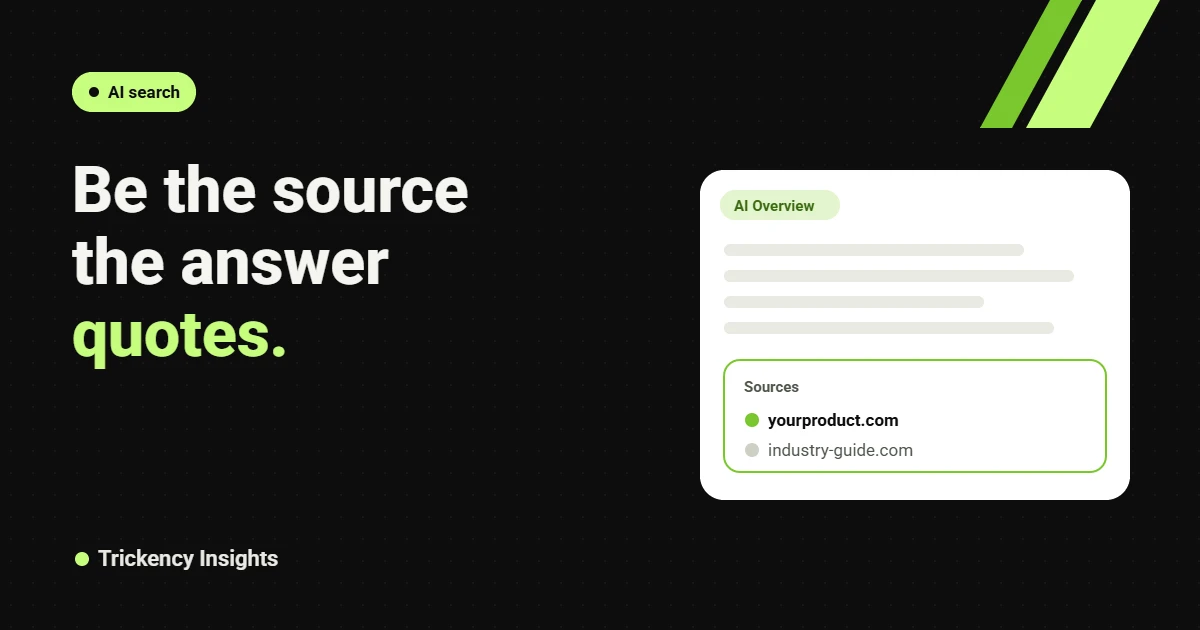
Google’s AI Overviews now sit above the organic results for a large share of informational searches. For B2B companies, that changes what “ranking” means. If the overview answers the question, many buyers never scroll. The brands that still win attention are the ones the overview cites.
The numbers make the point. Seer Interactive tracked 3,119 informational queries across 42 organisations and found organic click-through rate on queries with an AI Overview fell 61% between mid-2024 and late 2025. Brands cited inside the overview, though, earned about 35% more organic clicks than brands that were not cited. Being in the answer is now worth more than being below it.
Key takeaways
- AI Overviews reduce clicks on informational searches, but cited sources hold on to more of them.
- Pages that answer the question in their first sentence are far easier to quote.
- Consistency matters: your product facts should match across your site, review sites and directories.
- Comparison and “how to choose” content is cited more often than generic blog posts.
What AI Overviews are actually doing
An AI Overview is a summary Google writes from several pages it trusts for that query. It tends to pull short, self-contained statements: a definition, a list of options, a recommendation with a reason. It then links to the pages those statements came from.
That gives you a practical target. You are not trying to “optimise for AI”. You are trying to write the clearest, most quotable statement on the page that already ranks, or could rank, for the query.
1. Answer first, explain second
Most B2B blog posts open with three paragraphs of context before they say anything. AI Overviews skip those pages. Put the answer in the first sentence under each heading, then expand.
Compare these two openings for “how long does SOC 2 take”:
- “Security has never mattered more for SaaS companies…” (not quotable)
- “A SOC 2 Type I report usually takes 2 to 4 months; Type II needs an observation window of 3 to 12 months on top.” (quotable)
The second version can be lifted into an answer word for word. That is the goal for every section.
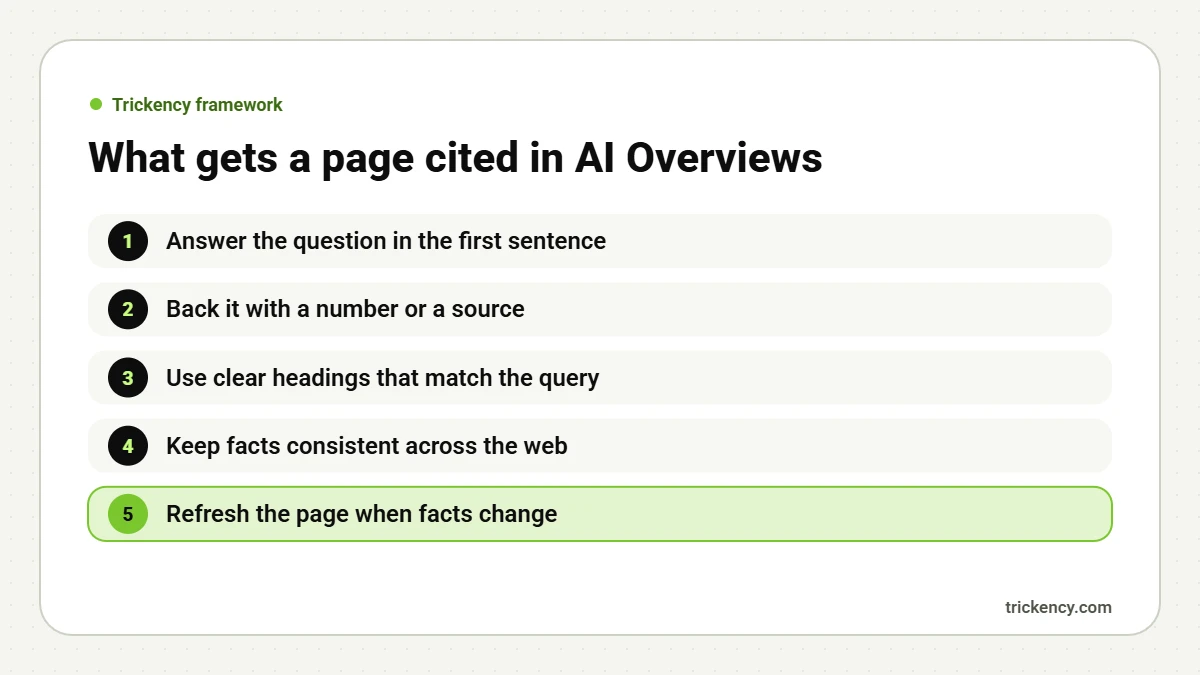
2. Give the overview something to cite
Overviews prefer statements backed by a specific number, a named method or a clear source. “Most teams see results in 3 to 6 months” beats “results take time”. Original data is the strongest of all, which is why we publish real figures from client work, such as the 529K+ organic clicks across five B2B SaaS sites.
3. Match headings to how buyers ask
Write H2s and H3s in the words your buyers use: “Is [tool] HIPAA compliant?”, “[Tool] vs [tool] for small teams”, “How much does [category] software cost?”. Matching the query exactly helps Google pick the right passage.
4. Keep your facts consistent everywhere
AI systems cross-check. If your pricing page says one thing, G2 says another and an old press release says a third, you look unreliable. Audit the places your company is described: your own pages, review sites, partner directories, LinkedIn, Crunchbase. Fix conflicting facts first, before you write anything new.
5. Build the pages overviews love to cite
From our work on AI search optimization, these formats get cited most often for B2B queries:
- Comparison pages (“X vs Y”) with a clear verdict. See how to build them.
- Alternative pages for buyers leaving a competitor. Our alternative-page playbook got a client named first in the overview.
- “How to choose” guides with criteria in a list.
- Pricing explainers that state real ranges.
6. Track citations, not just rankings
Add a monthly check to your reporting: for your 20 most important queries, note whether an overview appears, who it cites and whether you are one of them. Pair that with demo requests from organic search. If citations rise and demos rise with them, the work is paying off.
A worked example: rewriting one section to get cited
Take a typical paragraph from a payroll software blog, ranking around position six for “how much does payroll software cost”:
“Payroll software pricing can vary depending on many factors. Every business is different, so it is important to consider your needs carefully before choosing a provider.”
Nothing in that paragraph can be quoted. Here is the same section rewritten for citation:
“Payroll software for small businesses usually costs $40 to $150 a month as a base fee, plus $5 to $15 per employee. Full-service plans that handle tax filings and benefits sit at the top of that range. Expect setup fees only from providers that migrate historical payroll data for you.”
The rewrite answers the question in its first sentence, gives ranges a reader can use, and explains what moves the price. That is the shape AI Overviews lift. Do this for the ten pages closest to your buyers’ decisions before you write anything new. In our experience, editing existing pages that already rank on page one is the fastest way to start appearing in overviews.
What about pages that don’t rank yet?
Overviews mostly cite pages that already rank in the top results for the query, or for closely related questions. If you don’t rank at all, start with classic SEO: a page that targets the question directly, strong internal links from related pages, and a few credible mentions from outside your site. Then apply the answer-first structure. Citation is the reward for being both relevant and quotable.
FAQ
Can I opt out of AI Overviews?
You can limit snippets with robots directives, but that usually removes you from the overview and from rich results too. For most B2B companies, it is better to be cited than to opt out.
Do AI Overviews show up for B2B software searches?
Yes, especially for “what is”, “how to” and “best tools for” style queries. Pure brand searches and some transactional searches show them less often.
Is this different from getting recommended by ChatGPT?
The principles overlap: clear answers, consistent facts and third-party mentions. We cover assistants specifically in how to get your product recommended by ChatGPT.
Not sure if you show up? Our free audit checks Google, AI Overviews and ChatGPT for your top buying searches and shows you which competitors are being cited instead.
Sources: Seer Interactive study via PPC Land, November 2025.

The Trickency team writes about SEO, AI search and LinkedIn for B2B SaaS and tech companies, drawing on real client work since 2021.