Founder-led LinkedIn for B2B SaaS: a 90-day system that builds pipeline
Buyers trust people more than logos. A founder who posts useful, specific ideas on LinkedIn becomes the reason a buyer takes the first call. Here is a 90-day system to get there.
 Trickency Team
October 20, 2026
4 min read
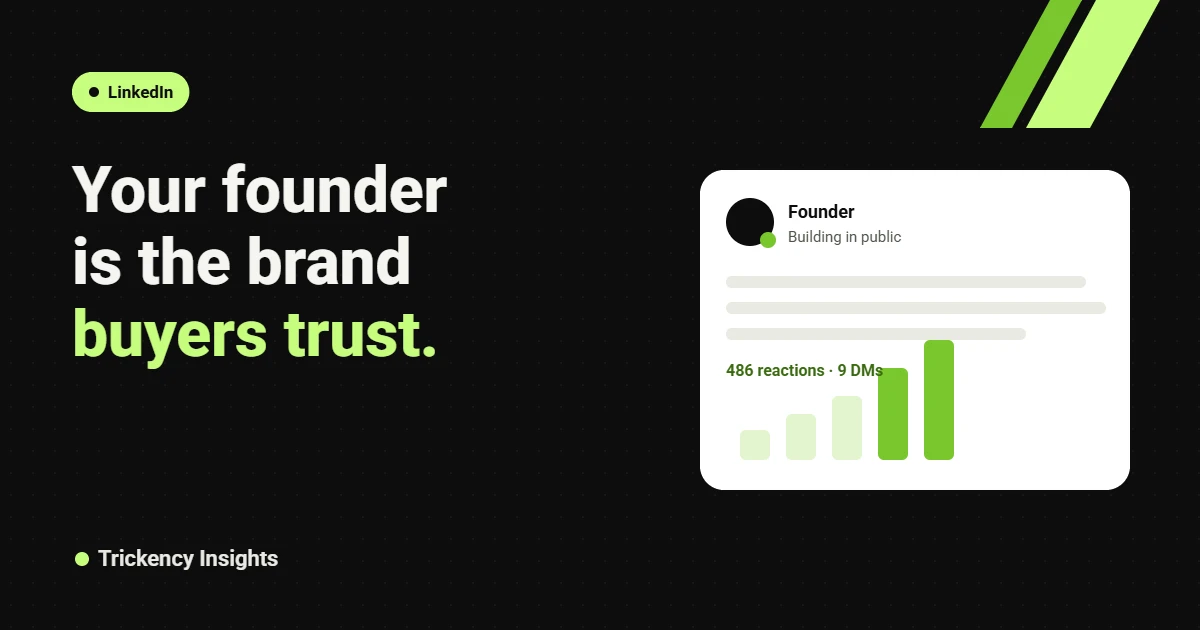
Founder-led LinkedIn works because B2B buyers want to know who they are dealing with before they talk to sales. In the 2025 Edelman and LinkedIn B2B Thought Leadership Impact Report, 95% of decision-makers said good thought leadership shows a supplier’s capabilities better than traditional marketing, and 79% said they are more likely to champion a vendor in an RFP if it publishes quality thought leadership consistently.
The catch is that most founder content is either too vague (“Hustle wins”) or too salesy (“Book a demo!”). Here is a 90-day system we use with B2B SaaS founders that avoids both.
Key takeaways
- Pick three topics only your founder can speak about with authority.
- Post twice a week and spend as much time replying as posting.
- Measure conversations started and demos booked, not likes.
- Repurpose the best posts into website content and sales follow-ups.
Weeks 1–2: Choose topics only you can own
Write down the three things your founder says on sales calls that make buyers lean in. Usually it is a strong opinion about the category, a lesson from building the product, and a pattern seen across customers. Those are your pillars.
For a loan-servicing SaaS, that might be “why funders lose money in collections”, “what we learned rebuilding syndication reporting” and “the three numbers every MCA operator should check weekly”.
Weeks 3–6: Post twice a week, reply every day
Consistency matters more than volume. Two strong posts a week beat a daily stream of filler. Use a simple mix:
- Point of view: a clear opinion with a reason. “Most MCA software is built for underwriting, not for the six months after funding.”
- Proof: a specific result or behind-the-scenes number, with permission.
- Teaching: a short framework or checklist buyers can use today.
Then spend 20 minutes a day replying to comments and commenting on posts from target buyers. Comments are where conversations start.
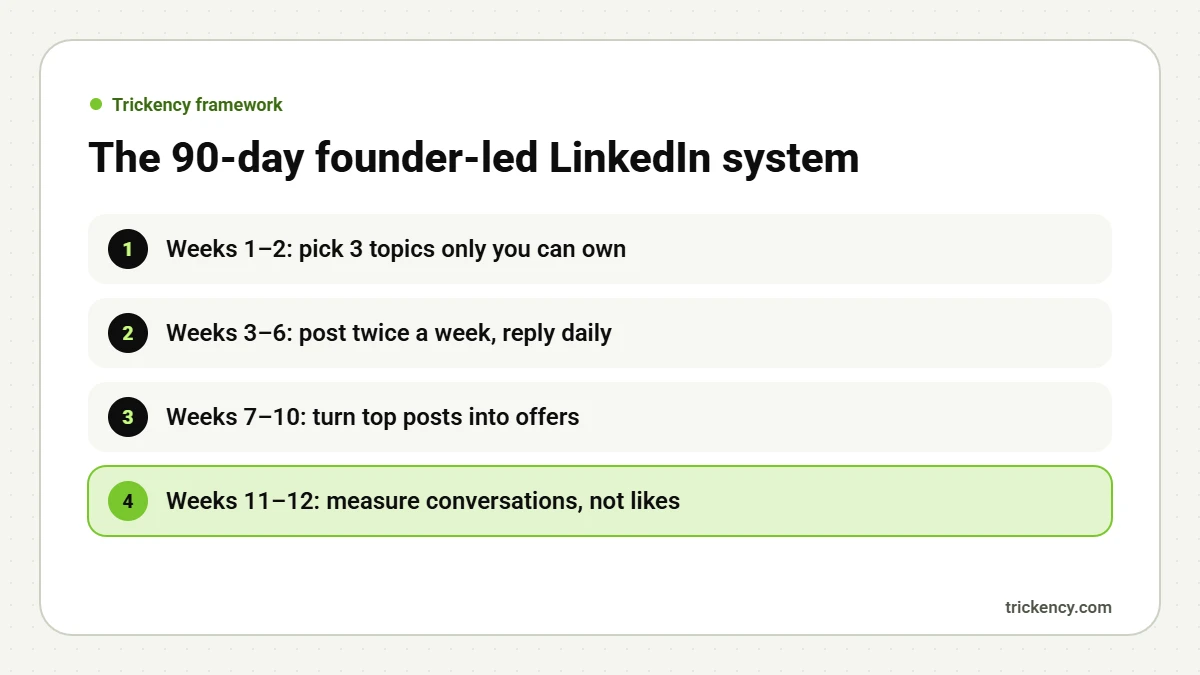
Weeks 7–10: Turn attention into conversations
Look at which posts drew comments from people in your ideal customer profile. Follow up with a relevant resource, not a pitch: “You mentioned reconciliation is painful. Here’s the checklist we use with customers.” A share of those conversations will turn into calls. Pair this with our LinkedIn outreach approach for accounts that haven’t engaged yet.
Weeks 11–12: Measure what matters
Track four numbers every two weeks:
- Comments from people at target accounts.
- Direct messages and connection requests from buyers.
- Conversations started.
- Demos where the buyer mentions LinkedIn.
Add a “How did you hear about us?” field to your demo form if you don’t have one. Founder content often shows up there long before it shows up in attribution software.
Make every post work twice
Strong posts make strong website content. Expand your best-performing post into a blog article, quote it on a service page, or turn it into a slide for your sales deck. It also helps AI search: assistants look for consistent, attributable opinions from real experts, which supports GEO.
Common mistakes
- Outsourcing the voice so fully that the founder no longer recognises it.
- Posting company announcements and calling it thought leadership.
- Giving up after three weeks because likes are low.
- Never linking posts to any next step.
Three post formats that work for B2B SaaS founders
The contrarian lesson
“We stopped offering a free trial and our demo-to-close rate doubled. Here’s why it worked for a product like ours, and when it wouldn’t.” A clear claim, a reason and an honest limit. Buyers remember founders who explain trade-offs.
The customer pattern
“In 30 onboarding calls this quarter, the same mistake came up 19 times.” Patterns from real conversations are uniquely yours, which makes them hard for competitors to copy and valuable to buyers who face the same problem.
The build-in-public moment
“Here’s the reporting screen we shipped last week, and the customer request that started it.” Showing the product in context, tied to a real need, sells without selling.
A realistic weekly time budget
Founders worry this will take over their week. It shouldn’t. A sustainable rhythm is about two hours: a 30-minute idea call every other week, 20 minutes reviewing drafts, and 15 to 20 minutes a day replying and commenting. The replying is the part founders most often skip and the part that creates most conversations.
How it connects to search and AI
Founder posts don’t rank on Google directly, but they create the demand that shows up as branded searches, and they give AI assistants attributable opinions from a real expert. When a buyer asks ChatGPT about your category and then sees your founder’s post the same week, familiarity does the rest. That’s why we run founder-led LinkedIn alongside SEO and AI search, not as a separate channel.
FAQ
Does the founder have to write every post?
No, but the ideas must be theirs. A good process is a 30-minute call every two weeks, then a writer drafts in the founder’s voice for approval.
How long until founder-led LinkedIn brings leads?
Most founders see the first buyer conversations within 6 to 10 weeks of consistent posting and replying.
Should the company page post too?
Yes, but people follow people. Use the company page to reshare the founder’s best posts and publish proof such as case studies.
Want this run for you? Our founder-led LinkedIn service handles strategy, writing and engagement, with the founder approving every post. Start with a free audit.
Sources: 2025 Edelman–LinkedIn B2B Thought Leadership Impact Report via Demand Gen Report.

The Trickency team writes about SEO, AI search and LinkedIn for B2B SaaS and tech companies, drawing on real client work since 2021.