B2B buyers decide before they talk to sales. Here’s what to publish.
By the time a buyer fills in your demo form, the shortlist is mostly decided. Here is the content that puts you on it, based on what buyers say they actually use.
 Trickency Team
October 21, 2026
4 min read
B2B buying has quietly moved out of the sales call. Gartner’s March 2026 survey of 646 buyers found 67% would prefer to buy without a sales rep, and 45% had used AI during a recent purchase. G2 reports that 51% of software buyers now start their research in an AI chatbot. By the time someone books a demo, they usually have a shortlist and a favourite.
That means the content you publish is doing most of your selling. The question is whether it is doing the right selling.
Key takeaways
- Buyers research alone, often with AI, before they contact anyone.
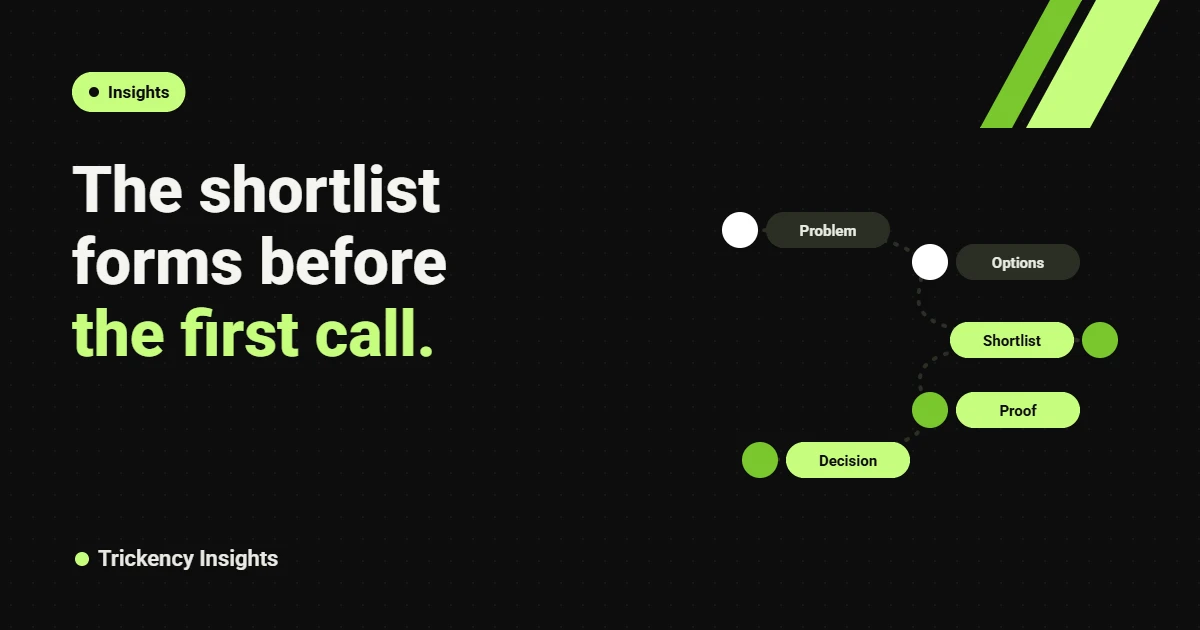
- Map content to five moments: problem, options, shortlist, proof and decision.
- The shortlist and decision moments are the most neglected and the most valuable.
- Make every page answer “Is this for a company like mine?” in the first two lines.
The five moments before the call
1. Problem: “Why is this happening?”
Buyers start with symptoms: rising churn, slow collections, flat organic leads. Articles that explain causes clearly, and name your category as one answer, bring you in early.
2. Options: “What are the ways to fix it?”
Here buyers compare approaches: hire, build, buy, outsource. A fair guide to the options, including the ones that aren’t you, builds trust and positions your category.
3. Shortlist: “Which tools fit us?”
This is where AI assistants now do heavy lifting. Buyers ask, “Best [category] for [size] using [stack]?” Your pages need to state plainly who you are best for. Comparison and alternative pages belong here.
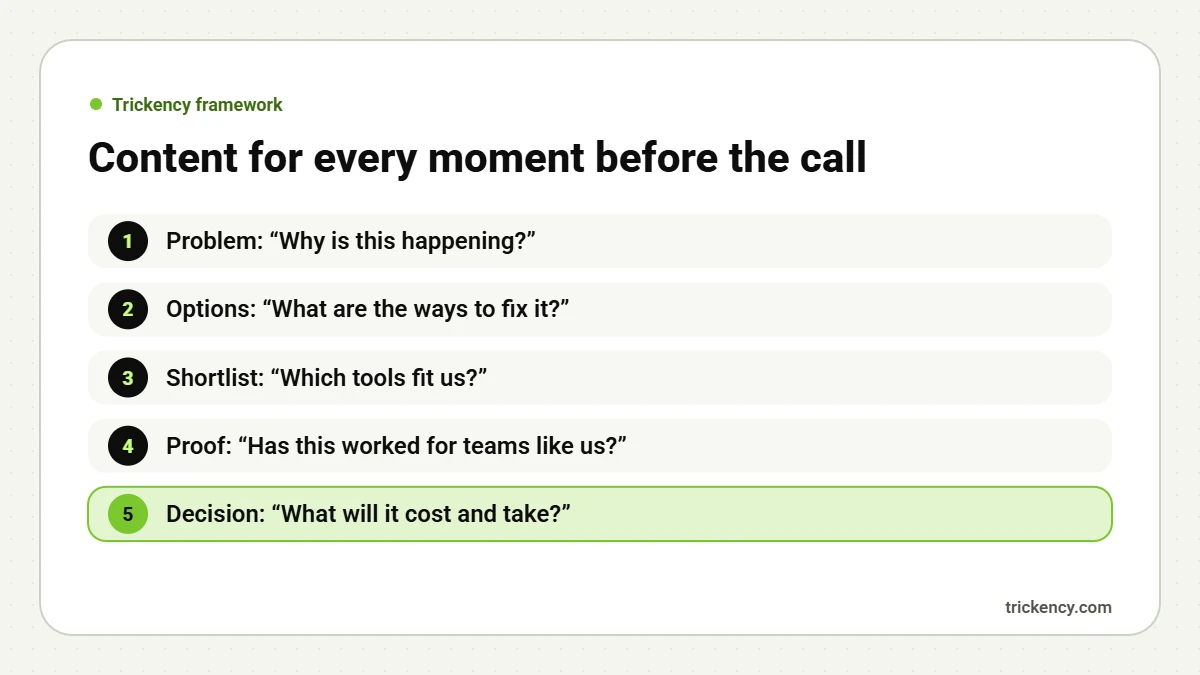
4. Proof: “Has this worked for teams like us?”
Case studies, numbers and named customers. Specific beats impressive. “433K organic clicks on one B2B SaaS site in 16 months” is more credible than “massive growth”. Put proof on product and service pages, not only on a case-study page. Ours is on our work page.
5. Decision: “What will it cost and take?”
Pricing, setup time, contract terms, security answers, migration effort. If buyers can’t find these, they assume the worst or pick a vendor that publishes them. Our guide to pricing page copy covers this.
Where most B2B companies have gaps
Most content plans are heavy on moment one and empty on moments three to five. Blogs explain problems; nobody explains why a buyer should choose this vendor, at this price, over that one. Those later-stage pages are smaller in number, quicker to build and far closer to revenue. They also feed AI Overviews and assistants at the moment buyers build shortlists.
A quick audit you can run this week
- List the ten questions buyers ask on your sales calls.
- Search each one on Google and in ChatGPT.
- Note whether your site answers it, and whether you are mentioned.
- Prioritise the gaps closest to the decision.
What this looks like on a real website
Here is a lean content map for a B2B SaaS company with a small team:
- Problem: two or three articles on the costly symptoms your product fixes.
- Options: one honest “build vs buy vs outsource” guide.
- Shortlist: a page per main use case, plus comparison and alternative pages for your top three competitors.
- Proof: two or three case studies with numbers, and proof blocks on every product page.
- Decision: a clear pricing page, a security and compliance page, and an implementation page that explains timelines.
That’s roughly 15 to 20 pages. Built well, they will do more for pipeline than a year of generic blogging.
Make AI tools describe you correctly
Because so many buyers now ask assistants for shortlists, add one more step: describe your company the same way everywhere. Use one sentence for what you do and who it’s for, and repeat it on your homepage, LinkedIn, review profiles and directories. Consistency makes it more likely that ChatGPT or Google’s AI Overview will describe you accurately when a buyer asks. Our guide to GEO vs SEO explains why.
How Trickency structures this
We organise our own services the same way: get found (SEO, AI search, content), get chosen (copy, website, brand) and get the conversation (LinkedIn, outreach, ads). Each stage maps to the moments above, so nothing a buyer needs before the call is left to chance.
FAQ
Does this mean sales teams matter less?
No. It means sales conversations start later and with better-informed buyers. Good content makes those calls shorter and more productive.
How much content do we need?
Less than you think. Ten strong late-stage pages often beat fifty generic blog posts.
Where does LinkedIn fit?
LinkedIn builds familiarity before buyers search, so your name is recognisable when it appears in results or AI answers.
Want to know what buyers see before they reach you? Our free audit checks Google, AI assistants and LinkedIn for your top buying questions.
Sources: Gartner, March 2026; G2 via Demand Gen Report, May 2026.

The Trickency team writes about SEO, AI search and LinkedIn for B2B SaaS and tech companies, drawing on real client work since 2021.